In the Sopranos Does Beansie Ever Walk Again
book excerpt
Does Tony Live or Die at the Finish of The Sopranos?
The ultimate debate most Goggle box'south most famous catastrophe.
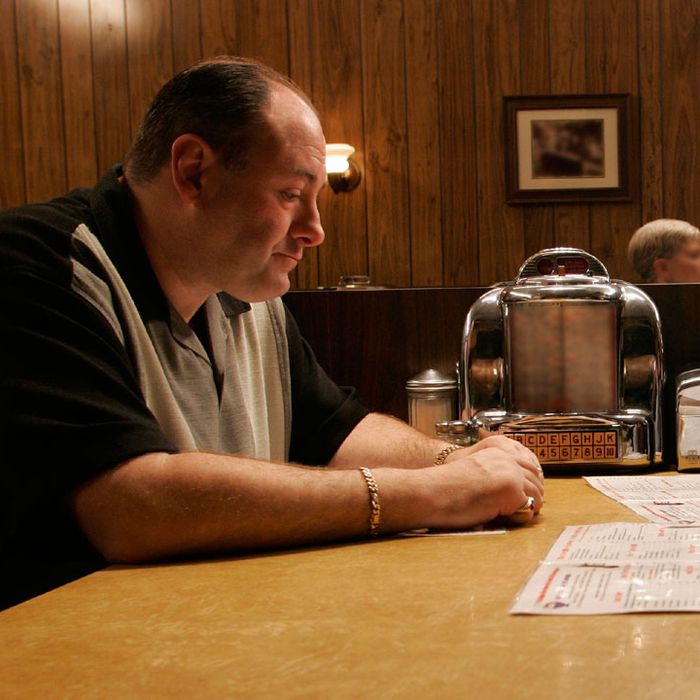
Don't stop believin' … y'all know exactly what happened at the finish of The Sopranos. Photograph: Will Hart/HBO
Don't terminate believin' … you know exactly what happened at the stop of The Sopranos. Photograph: Will Hart/HBO
Before I wrote about tv for New York Magazine and Vulture, I wrote nearly it for the Star-Ledger, New Jersey's largest daily paper, sharing a beat with my friend Alan Sepinwall, who is now the Television set critic for Rolling Rock. The highlight of our time together was covering The Sopranos, which shot in the paper'southward circulation area throughout the state.
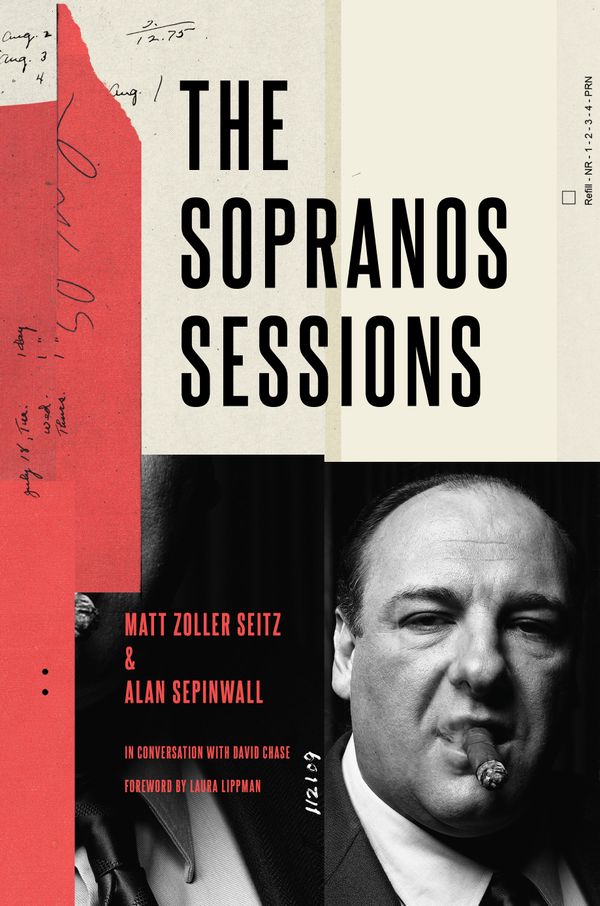
On the occasion of the show's 20th anniversary, we've published a volume about it, The Sopranos Sessions, combining reviews of each episode, a new interview with series creator David Chase, and selections of our Star-Ledger manufactures about the testify. At the same fourth dimension, IFC Center in New York City is hosting The Sopranos Film Festival, a mix of episodes, features, shorts, cartoons, and console discussions. The schedule includes the premiere of My Dinner With Alan, a characteristic-length documentary in which nosotros sit down in the famous booth at Holsten's and discuss the series and the experience of covering information technology for the paper that Tony used to pick up at the end of his driveway.
The following is an excerpt from The Sopranos Sessions, in which Alan and I debate the nevertheless-controversial concluding 4 minutes of the testify and come to unlike conclusions nearly what information technology meant.
Alan Sepinwall: Tony Soprano is dead.
Matt Zoller Seitz: Wait, what?
Alan: He's dead, Matt. It's obvious.
Matt: Well, this isn't how I idea this would become. To quote Tony, the floor is yours, senator.
Alan: "Made in America" opens on Tony asleep in the safe business firm. His eyes are airtight, he's not noticeably breathing, and the camera angle makes it look like he'due south lying in state at the funeral parlor, waiting for his friends, family unit, and viewers out hither in TV state to pay our respects. He jolts awake within moments, but we begin our final hour in Tony's company with this prototype of him suggesting that he'south already dead, and that he only — like Silvio watching the Gerry Torciano hit — needs some time to catch upwardly with the certitude of the situation.
That coffinlike image isn't the first major allusion to death of the terminal flavor, nor the last of "Made in America" alone. In the season premiere, Bacala raised the idea of what happens when yous die, speculating, "You probably don't fifty-fifty hear it when it happens, right?" — a line so clearly important to the finish of the series that the conversation is replayed at the stop of the penultimate episode, after poor Bobby had that question answered. Images of death — or a Hell frozen over from overcrowding and neglect by management — abound throughout the series finale, equally the testify's usual fascination with the extremes of weather in the Garden State gets amped up to an most supernatural degree. When Tony'southward coming together Agent Harris by the airport, or Butchie is wandering through the last remaining scrap of Piffling Italian republic while talking to Phil on the phone, or when Tony and Butchie and Piddling Carmine sit down to broker a peace in that clangorous truck depot, the common cold and wind and snow are all so palpable that the just truly applicable phrase is, "You'll catch your expiry."
And that'south fifty-fifty before nosotros get to Holsten's, a scene shot and edited unlike anything else in the history of this show.
Matt: Yep, simply why does a preponderance of imagery related to death and disuse mean that Tony had to be shot expressionless at that diner at that exact moment? This is what I keep coming dorsum to. I don't believe it'due south necessary to constitute that to discuss the ending of the show, nor do I think the bear witness necessarily points to that.
Whenever the Sopranos ending is discussed, and somebody starts with the presumption that Tony is dead, I ask the same follow-upward question: "Why practice y'all need for Tony to exist dead?" Because you have to need him to be dead to insist not only that he got shot right there in the diner, simply that him being dead is in fact the entire point of the scene, and that no other arroyo is permissible. Because nothing in that scene says, "Somebody but killed him and that's what the cutting to blackness is virtually." The but objectively true statement that can be made virtually that ending is that information technology'due south ambiguous. Spending long hours trying to bear witness Tony was shot at the diner becomes a substitute for meaningful appointment with the show'southward themes, which are disturbing not just because of their implications, but because Chase and the writers present them in an open-concluded, mysterious, or deliberately opaque mode, like a brutal reminder to usa that nosotros can't absolutely know sure things, and it's delusional to insist we can.
The final close-up of James Gandolfini's confront contains no note of fright or anticipation. He's only looking up at the sound of a bell ringing, and if classical continuity editing is to be our guide here, the person entering is Meadow, last seen in the 3rd-to-terminal shot of the scene, walking toward the diner. I suppose yous could fence that somebody snuck in from the side, out of frame, and shot Tony. But again, that seems like a reach to me, peculiarly since Members Just Guy hasn't come out of the bath yet. And, as I said, it proceeds from the speaker'due south demand to have Tony die at that moment, non from any show in the scene itself.

Alan: I hear what you lot're saying. Only the very fact that Chase devotes so much time to what seems similar goose egg makes the whole scene all the more nerve-racking. To paraphrase one of the Four Questions from the Passover seder, on all other nights we don't watch Meadow endeavour to parallel park even once; why on this night do we sentinel her attempt to parallel park over and over over again? Why is this dark dissimilar from all other nights?
Chase lingers on the parking chore to raise the question of what terrible affair will happen considering information technology'south taking her so long. Chase provides glimpses of all the other customers — a watch troop, 2 unidentified black males at the jukebox, a man in a Member'due south Only jacket similar Eugene Pontecorvo'due south at the counter — because he wants us to wonder if one of them might be at that place to take out Tony. (Well, maybe not the scouts.) Chase lets the tension build and build and build — including Members Only Guy walking by Tony and into the men's room — so that we'll be primed for something awful to happen as Meadow sprints across Broad Street and into the eating place. Hunt replayed the Bacala decease line and laid downwards so much death imagery throughout the flavor and this episode, and then nosotros will understand that when the scene jarringly cuts to black, it's because Tony has just died, either via a bullet from Members But Guy or a coronary from ane onion ring too many.
Expiry is what happens, cease of story, right? We can all go home now. Frankly, I'g not even sure why we're nevertheless debating this.
Matt: All right, permit me back up for a 2d and say that at no point during my at present x-plus years of arguing almost the significant of this scene take I said that "Tony died" is an inconceivable or unacceptable estimation. It's not wrong. In fact, it's the virtually obvious interpretation, given that Tony's pissed a lot of people off over the years, and in the overwhelming majority of gangster stories, the main guy dies at the end. Plus, that concluding stretch of 21 episodes does have a persistent chill, visually and plot-wise — a series of deaths and declines, with a lot of the color bleached out. So absolutely, the show is putting united states in a frame of listen to anticipate a expiry.
Simply I don't think he has to be expressionless for u.s. to think nigh all that related stuff, and I don't think that's the merely possible interpretation. He could've had a coronary or another panic attack. Or it could exist, equally I wrote in my original recap hours after the finale aired, that the character who died in that location was us, the spectator.
We don't get to watch the bear witness anymore. He whacked the viewer. Or maybe nothing happened in that scene, but Tony went on being Tony and maybe died of centre disease or Alzheimer's, which, given all that nosotros've seen him go through, is a sadder outcome.
I call back we're supposed to be thinking nearly death, or the finiteness of life, during that final scene, merely not necessarily that Tony died correct so and at that place, and that's the end of the story.
Because, while yous're right to bespeak out how Hunt and visitor have very deliberately put us in a death-obsessed frame of mind during this concluding run, during the preceding seasons he showed us time and time again that he was never interested in doing the obvious thing. And the unmarried near obvious affair to exercise in a gangster motion picture is to kill the main graphic symbol — out of reflex, or because the storytellers want to limited that crime doesn't pay.
Remember, too, that Tony is the Homer Simpson of offense bosses, miraculously avoiding death or prison house even as it claims other characters. Remember about the randomness of him seeing the FBI agents coming over the hill and escaping even as they abort Johnny. Or him surviving three car wrecks, one of which fatally wounded Christopher. This guy lives a charmed life. So does AJ, who luckily fails to kill himself — Tony happening to come dwelling at that moment is a Tony quotient stroke of skilful luck — and in this very episode, the kid survives a truck explosion. What'due south more than in graphic symbol for The Sopranos, to kill a magically overjoyed character in the final scene, or to refuse to do so?
Alan: I don't know the reply to that hypothetical, because either one seems similar the kind of thing The Sopranos might do.
Matt: The bespeak is, The Sopranos resisted all the usual gangster film reflexes for seven seasons. I can't imagine that it would succumb to them in its final moments, no matter how great the temptation — and as our conversations with Chase confirmed, that temptation did exist. In that location has to exist something else going on here, otherwise the scene wouldn't end as it ends, in such a studied "inartful" fashion. I hate that when you lot enquire, "What happened at the finish of The Sopranos?" and people just shrug and say, "Well, he died!" A better question is, "What did that ending mean?"
Alan: Yeah, I would say the coexisting testify of death in the scene is overwhelming. But is that enough to captive Chase for murdering his main graphic symbol? I mean, if you stride dorsum and think almost it, killing Tony this mysteriously does defy Sopranos modus operandi in multiple ways.
Matt: Aha! Doubtfulness.
Alan: Other than possibly the revelation that Big Pussy was an FBI cooperator — a plot thought conceived in the show's embryonic stages, without Chase expecting anyone would care almost him resolving it — The Sopranos tended to keep its plot cards face up. Y'all knew near everything important that was going on, not only with Tony, but with all his enemies and allies. At this moment in "Fabricated in America," nobody that we know of wants Tony dead. Phil is gone, Butchie made peace with New Jersey, and anyone else who might wish Tony a violent end is out of the motion picture.
A homo in Tony's business volition always have enemies — Eric Scatino probably still nurses a massive grudge — and then information technology'southward not outside the realm of plot logic that some rando or long-forgotten character could have hired Members Only Guy to do the deed. (For that matter, Members Merely Guy could be the loved one of a Soprano victim himself.) Simply information technology'south an enormous jump from how the series told stories in every scene, and episode, upwardly until this ane.
Matt: Yes. And I would contend that, if the main takeaway from that scene is, "Oh, they shot him," then either the show has failed and suddenly decided to give up and be a typical gangster story in its concluding four minutes, or at that place'southward something else happening here.
I vote that there's something else happening. And if it helps to motility the discussion beyond the question of whether he's expressionless or alive, I'll just say, "Fine, he's dead." And now what? What does that get out us with, if that cutting to black ways somebody somewhere shot Tony? What is this ending saying? Or if nosotros can't discern that, what is this ending trying to make u.s. think about?
Alan: Mayhap we should ask the true cat. The show absolutely dabbled in the supernatural throughout, from Paulie being haunted by Mikey Palmice, to Tony dreaming something that Tony B was actually doing, to whatsoever and wherever Kevin Finnerty was. At that place's a reason The Twilight Zone keeps coming upward, whether in chat or on the prophylactic house TV in the finale. The cat turns upwards at the safety firm and gets brought back to Satriale's, much to Paulie'due south horror — "Yous tin can't even put them near a baby; they suck the jiff right out!" — particularly once it starts fixating on a photo of Christopher from the fix of Cleaver. Is this, the superstitious Paulie wonders, but a cat, or his late colleague returned to life? Sometimes, a true cat is merely a cat, simply information technology's hard non to consider this one within the context of what happens, or doesn't, a few scenes later at Holsten's.
The Austrian physicist Erwin Schrödinger famously theorized that if you identify a true cat into a box with some kind of hazardous fabric, the true cat may live or die, merely until you lot really open the box to cheque, the true cat is simultaneously dead and alive. Perhaps the wiseguy who has turned into a cat — Schrödinger's true cat, to exist precise — isn't Christopher, but Tony?
Matt: What do you mean by that?
Alan: What I mean is, possibly that true cat is Christopher reincarnated, or peradventure it'due south just a cat that won't stop hanging around Satriale's and staring at a photo of Christopher. We don't know, and will never know. And thus, that cat is Christopher and not Christopher at the aforementioned time.
Matt: Simply like the Holsten's scene. And the Russian. And the thing of whether Ralphie was responsible for the fire. Past telling other people what we think happened, nosotros are revealing ourselves. We're admitting who we are.
Alan: Aye, the Holsten'due south scene is about death — specifically, nearly the idea that we are all here on borrowed time, and our lives can be snatched abroad at any moment, without alarm or caption or the slightest hint of fairness.
Matt: "Death shows the ultimate absurdity of life." —AJ Soprano. Fuckin' cyberspace.
Alan: There'due south no way effectually that, and even David Chase says as much in the sixth interview afterward in this volume. And it's truthful that, the longer the Holsten's scene and the parallel parking continue — and on and on and on — the harder it becomes to shake the feeling that Tony, or Meadow, or peradventure everybody, is most to get whacked.
Simply the scene can exist near the idea of Tony's imminent demise without actually featuring it — and, if we're beingness stubbornly pedantic, it doesn't feature it. Meadow runs to the door, the bell rings, Tony looks upwardly, and … nothin'. You lot can interpret that cutting to black whatever way you want it (to quote the other Journey song featured on the jukebox right below "Don't End Believin'"), just maybe Tony is the cat: dead and alive at the same time, because nosotros can't see into the box to know for sure.
James Gandolfini in The Sopranos finale. Photograph: Will Hart/HBO
Matt: Well, that'south been my overall point in these arguments from the very beginning, and I'm glad y'all framed it in those terms, because it does a prissy terminate run around the whole "Tony Soprano, dead or alive?" question, which I've ever idea was an attempt to change the question mark at the finish of the sentence to a period. I remember "Tony died at that moment" is a valid estimation. Simply I too think information technology's fair to say that he lived beyond that moment, even to a ripe old age, because ultimately this scene is making united states ask, "What take we learned?" or "Where have nosotros been?" and "Where is Tony, correct at present, every bit a person?" These are reckoning questions, and they tin can occur at many different points in a person'due south life.
Of form, these questions occurred to Tony later Junior shot him, and that
his response was to absorb rather shallow lessons — like, brand ameliorate choices in the moment, and try existence a better listener — while ignoring bigger ones like, "Maybe you're depressed all the time because you're a gangster." Melfi steers him toward this realization throughout the series, even in the airplane pilot. Just he always manages to avoid going there. I think the ending is sadder and more powerful if you think, "All those people he killed, all those people he loved that died, all the stuff he's been through personally, including getting shot and being in a coma — none of that really made much of a dent in this guy's thick skull."
Alan: Okay, but then, why the cut to blackness? Why the ambiguity at all? If the scene's almost the fragility of life, and the omnipresent specter of death that leaves usa all fumbling about for meaning in this cold, cruel earth, why leave fifty-fifty a trace of ambivalence? Why cutting to blackness on that shot of Tony'due south uninflected face, as opposed to a glimpse of Members Just Guy raising a pistol, or even Tony looking distressed as his torso deals with a gunshot, a coronary, a stroke (like the ane that killed Livia), or some other cause of sudden death?
It could exist that Chase simply likes ambiguity and defoliation. Blow-Upwardly is one of his favorite films, and it has a famously non-definitive ending that invites the viewer to project their own meanings. He was never interested in the Russian, the rapist, the stable burn, or whatsoever of the other characters and threads that he left dangling over the life of the serial, except as forces that examination the main characters and reveal their essence.
Or information technology could be like the decision in "Long Term Parking" to not just provide a glimpse of Adriana's fantasize where she just gets in her car and heads south on I-95, merely to deliberately stage her death scene so that she's off-camera when Silvio fires the fatal shot. Maybe, after spending a decade telling stories nearly this man — and having spent a whole lifetime thinking many of the aforementioned thoughts every bit Tony, especially where their mothers were concerned — Chase just couldn't bring himself to direct a scene explicitly killing him, or even 1 where he asked James Gandolfini'south face to signal us more than blatantly in that management.
Matt: Well, that's interesting, because it brings Chase himself into the mix, and I remember nosotros both should admit that our estimation of the ending is affected by our conversations with him while writing this book.
And by that, I don't mean he handed united states of america the answer, considering The Sopranos was never the sort of prove that fabricated you chase for answers in that manner. I just mean that Schrödinger'south cat is useful if you lot're applying it to a story that could end either in a radical, art-house movie way, or in a traditional way, merely with a fancy wrapping.
Alan: Information technology's hard to play dumb well-nigh what nosotros discussed with Chase, but the slap-up affair — or the maddening thing, depending on your bespeak of view — is that even with all he ultimately told us, there's still no definitive reply to the dead/alive question. Nosotros know what the scene ways, but we don't know what happened.
Matt: An important stardom. Aye, I was thinking that, likewise — that despite the hours we've spent talking to Chase about the catastrophe, I don't think it's necessarily been "explained" in any meaningful sense, in terms of what happened next, and I get the impression that Hunt can't really explain it either. Information technology's not an insult to say that he doesn't actually know why he did what he did, because all through our interviews with him, we kept trying to get him to explicate the reasoning behind certain choices, but to notice that in that location wasn't any, and he and the writers and directors were just doing what felt correct.
That final scene is something he felt was correct, and that came out of his want to subvert or amend the traditions of the gangster movie, while maybe coming to terms with the fact that he was unable to escape them. This is a show that's very interested in dream language, psychoanalysis, and the contradictory, mysterious forces that brand us who we are, and information technology's inevitable that this serial, perhaps more than other works of art, would have become a Rorschach test.
Alan: Tony'due south state of affairs as he enters Holsten's is complex however you lot look at it. Professionally, he has only survived a war with New York — has, in fact, enough juice that he was able to impale a rival boss with the tacit approving of Phil's successor — but his organization is in a slaughterhouse. Paulie, long the near useless helm on the payroll, is the just major marry he has left.
Personally, he's on good plenty terms with his immediate family that they'd all happily join him for onion rings and more at their favorite ice cream identify. And, other than a couple of ugly fights, he has been getting forth much better with Carmela since she took him dorsum than he always did during the first vi seasons of the evidence. But Meadow is marrying into the extended Family past getting engaged to Patrick Parisi and becoming a lawyer — two things Tony never wanted for her — and AJ recently survived a suicide and is so lacking in direction that this depression-level job working for Footling Cherry feels similar a salvation. Then when he walks into the eating place, judgment has already been passed, or maybe suspended. He is either an enormous success or a pitiful failure.
Matt: Or he can be both.
Alan: The true cat.
Matt: Yes.
Alan: Let me ask you this, then: If, during one of our many conversations with Chase, he had invited united states of america to lean in close, and whispered, "Guys, Tony's expressionless," how would that change your feelings about the catastrophe? And, flipping that, what if he'd whispered, "Guys, Tony's live"?
Matt: If he'd said, "Yeah, I killed him," I would've been deeply disappointed in Chase. Because it would've meant that he did the most obvious thing so tried to hide information technology by making it seem as if he was creating an ambiguous or fine art-business firm type of ending. And I think I would take been equally disappointed if he'd said, "Tony is live." And that's because I similar not knowing, and to me, everything most this ending says, "Yous're non supposed to know, you're supposed to alive in the not-knowing."
A lot of characters live in that location and have to brand peace with information technology. The loved ones who lost people to "witness protection" or because they "ran away" suspect they were murdered only tin can't evidence information technology, even though we viewers saw it happen.
This ending puts us in their shoes. We make upwardly stories to reassure ourselves that we take control over life, and nosotros really don't. I'm reminded of that moment in "D-Girl" where Dr. Melfi summarizes existentialism for Tony. "When some people first realize that they're solely responsible for their decisions, deportment, and beliefs, and that decease lies at the stop of every road, they tin be overcome with intense dread … a deadening, aching anger that leads them to conclude that the only absolute truth is death." I call up the insistence on "proving" that Tony died is a means of reasserting command over the show, and over the life of the person doing the proving. Death is the but absolute truth for everyone, and if you lot read that ending just as "he died," you tin wash your hands and walk away from information technology and not have to think virtually annihilation else that might be raised in that scene.
This is a prove about either accepting that you're not in control of anything, or making a conscious conclusion to deny that. The idea of presenting the catastrophe equally a thing that tin can be mastered and explained is philosophically the opposite of everything that led usa to that signal.
I know this is a minority reaction, but I like being baffled or challenged or frustrated by art. I like having to make a case for a item estimation or just throw my hands upward. It's fun for me. What I don't like is any kind of conversation that seems to be leading toward, "He's dead, stop of discussion." Because that should not be the cease of the discussion when you're talking about a evidence similar this 1, a evidence about psychology, development, morality, and all these other deep and tangled subjects.
The way the ending teases audiences by seeming very definite while denying us answers and closure makes it the ultimate Sopranos moment. And it throws all the other things we've been discussing, here and throughout this book, into sharper relief. Because it's taking the question of whether Tony lived or died off the tabular array.
Alan: I spent many years after the finale every bit a menu-conveying, vocal member of Team Tony Lives. I made arguments similar the one above, well-nigh how a surreptitious assassin repping an enemy nosotros never heard of before would disharmonism with every narrative rule the show always followed. More recently, I institute myself swaying over to Team Tony Dies, not only considering of the death imagery throughout the season — including the way then many episodes open, every bit this ane does, with Tony waking up from a deep sleep — but considering some of my initial, long-hardened impressions of the scene didn't hold up nether farther scrutiny.
I had thought, for instance, that the sense of paranoia instilled in the viewer by the rapid editing style Hunt uses for the scene was shared by Tony himself — that, peradventure, the point of it all was to finally put the states in the heed-ready of the principal character, to make the states realize, "This is how miserable it is to exist Tony Soprano: to spend every infinitesimal of every twenty-four hour period worrying about who could be coming through a door to impale yous."
Merely all that stuff exists outside the text, not in it. Gandolfini'southward playing it as Tony enjoying a peaceful night out with Carmela and the kids, upward to and including that final look on his face in betwixt when the bong rings and the screen goes black.
Matt: Aye, he's checking out the scene in there for self-protection, but he does that everywhere he goes.
Alan: So for a while, it seemed easier to merely go with the idea that he dies — that the cutting to blackness follows on Bacala's line from "Soprano Home Movies," Silvio's reaction to the Hairdo's death in "Stage 5," and all that death imagery. I idea virtually Tony's entrance into Holsten'due south in the context of the earlier scenes where he visits Janice then Junior. In both of those, Chase employs an unusual editing style, cutting directly from a shot of Tony looking out at the space he's just entered to a unlike point of view where he's already crossed near of the altitude to the relative he's come to run across.
Matt: Yes! And the music is continuous throughout. Bits of time are elapsing in terms of the physical motility of Tony in that infinite, merely that'southward not indicated by the music, which never stops. That's i more reason why this scene feels dreamlike, forth with all those incidental characters, like Members Only Guy and the uniformed Boy Scouts, who experience like people you'd run across in an '80s music video. I retrieve you could brand a improve case for Tony Dies if you presume he's dead before this scene fifty-fifty starts.
Alan: The distance he walks is shorter each time, and when he gets to Holsten's, nosotros simply cut from him looking at the restaurant to him in the booth, in a way that suggests he'south seeing himself — really, that he's seeing the whole scene play out, similar he's already left his body and is just envisioning what might come next back on this mortal plane. And so it felt better to become with "Tony died." It was An Answer, in a way that "Tony lives" never entirely felt like 1 to me, and when Chase wrote that commodity virtually the scene for DGA Quarterly, and talked about the fragility of our mortal existence, I was able to smile and say, "Aha! That'south it! I know now, and I don't have to worry about this anymore."
Except the longer you and I talked near information technology, both on our own and with Chase, the less substantial that idea felt, too, until by the end, I wasn't entirely sure that even Chase knows if the guy's dead or alive. And does that matter?
Matt: You mean does information technology matter if Chase knows what happened? No. It's become increasingly clear to me as nosotros've worked our manner through the entire series again, with over 10 years of perspective on that finale and nigh 20 years of living with the bear witness in some form, that Chase is an intuitive writer, somebody who'south not trying to send messages or create puzzles for people to solve, but is just trying to make people feel and think and question themselves.
It'southward likewise easy to see that Chase is of ii minds on the last scene. Which is perhaps something he telegraphed by bringing that cat into it. This is an artist sorting through contradictory impulses, in hopes of reaching audiences in a deep way. There are no cookies for figuring things out.
Alan: Okay, so a hypothetical: Either way yous lean, what happens subsequently that cut to black? If Meadow simply walks in and the family enjoys the rest of their onion rings, a squeamish repast, and some water ice cream, what happens to Tony Soprano after? Does he sweat and strain rebuilding the Family after the damage Phil inflicted upon information technology? Do the Feds show upward a week later to arrest him, Carlo having finally given them the missing slice of their RICO prosecution? Is the Daniel Baldwin script a huge hit at the beginning of AJ's shocking career every bit a Hollywood tastemaker?
And if Tony drops dead after the bell rings, whether from a bullet or (like poor Gigi Cestone) internal distress, obviously the next few moments involve Carmela, Meadow, and AJ existence horrified and grief-stricken, but what comes after? Does Tony's expiry alter the career plans of either kid? Did he really leave enough money in overseas accounts to take intendance of Carmela after his passing, or will she soon be taking Angie Bonpensiero'due south former job passing out supermarket samples? Does Paulie freaking Walnuts somehow get boss of the Family, or does Butchie throw upward his easily at this point and decide to put his own guy in charge of the gang that couldn't shoot straight?
I ask this not to spoil the details of the many pieces of Sopranos fanfic I take saved to the cloud, merely to consider the larger question: Which ending is more interesting? Whether we get to see what comes next or not, which is a more entertaining, exciting, and/or thematically fitting conclusion to the story of The Sopranos: Tony's precipitous death or his continued existence?
Matt: I think it'south more interesting if he lives. I recollect it would fit with the cycles of experience depicted in the series. This guy has much more self-awareness and sensitivity than other people in his line of piece of work, but is still a prisoner of his conditioning and perhaps his genes, and always seems to autumn far short of enlightenment. And if, to quote Mad Men, the greatest predictor of what somebody is going to do is what they have done in the by, Tony's always going to basically be Tony, the loquacious gangster who puts himself first.
I think it's likewise interesting if he dies, though that'southward a less disturbing ending to me, because it'due south the standard gangster-story ending, and no thing how yous read information technology, for reasons of genre history it always comes back to "Don't exercise offense, kids."
Alan: Back in the day, I felt like decease was an easier sentence for Tony to take, because so much of his life — thanks to genetics, mental health, and the monstrous business he has chosen — brings him and then much misery. But in rewatching the series and writing this volume, it'south articulate that amongst Tony Soprano'south greatest gifts is his ability to alive in the moment, shrug off the overall pain and paranoia of his life, and enjoy the many fruits that come up with being the boss of New Jersey.
Matt: "If you're lucky, yous'll remember the little moments, like this, that were good." The end of flavour one.
Alan: Correct. So possibly he'd accept a relatively fine quondam time drifting into old age. The day James Gandolfini died — in sudden, startling fashion that sadly evoked the very themes Hunt was trying to convey with this scene — I wrote that, "as horrible a human being being every bit Tony was, it gives me a pocket-size bit of comfort on this surprising, terrible day, to imagine Tony still alive, waddling out of his SUV and into the pork shop, or calling up Dr. Melfi for 1 more shot at therapy."
Now? Now, I'thousand Schrödinger's critic: equally intrigued by the idea of Tony living and Tony dying. I understand what the scene was nearly — and, more importantly, I know how information technology made me experience the outset time I watched information technology, every time since, and through all these conversations I've had with you and the balance of the Sopranos-loving globe about it over the final decade. I felt then, and now, afraid for Tony Soprano, and painfully aware of both his delicate mortality and my own, more than keenly than whatever other piece of art has made me feel. That matters much more to me, ultimately, than a definitive answer.
Matt: At that place was a moment a few years ago when a journalist reported that Chase told her Tony lived, and he got mad at that — as mad as he's gotten at all the people who continue proverb Tony died. But what he said, specifically — and he was directing it toward everybody — was, "Whether Tony Soprano is alive or dead is not the point. To go along to search for this reply is fruitless. The final scene of The Sopranos raises a spiritual question that has no correct or incorrect reply." I think the almost important two words in those 2 sentences are "spiritual question." And if we fixate on anything other than that, we're missing the signal.
When people ask me, "Do you recall Tony died?" I sometimes answer, "Of class." And so I break and add together, "Sooner or afterward, everybody does." Which absolutely is a dickish matter to say — but you know what I mean? That bell, to me, is a tolling bell, as in "Bring out your dead." Information technology rings every fourth dimension somebody goes through that door. I'm not saying "Holsten's is Sky!" or anything like that. I mean it's a prompt for the states to think most death and life, and what nosotros've done with our lives.
Peradventure the ending is moralistic, only non in the way that some of the people who need Tony to exist dead might frame it. Perchance the catastrophe is saying, "This guy never got information technology. Are you gonna be like him?"
Alan: This is earth-shaking, and nosotros'll see what happens to the chat now that the phrase "decease scene" is out at that place. Nosotros only have this one life, and precious little control over how long it lasts. How do we cull to live it? Tony Soprano has clearly made many bad choices, as have the other people at that table with him, as have nearly all the characters with whom we've spent these 86-plus hours of television. I think you and I are in agreement on the larger indicate of the scene, correct, Matt?
Matt: What betoken is that?
Alan: Obviously, he'southward live.
Matt: ALAN.
Excerpt from the new book The Sopranos Sessions past Matt Zoller Seitz and Alan Sepinwall published by Abrams Press; © 2019 Matt Zoller Seitz and Alan Sepinwall.
"This Magic Moment," by James Greenberg. Directors Guild of America Quarterly, Spring, 2015. Hunt:
"I thought the possibility would go through a lot of people'due south minds or perhaps everybody'due south mind that
he was killed. He might have gotten shot iii years ago in that situation. Just he didn't. Whether this
is the end here, or not, information technology'south going to come at some point for the rest of united states. Hopefully we're not going to
get shot past some rival gang mob or anything like that. I'chiliad not saying that [happened]. Simply obviously
he stood more of a chance of getting shot past a rival gang mob than you or I do because he put himself
in that situation. All I know is the terminate is coming for all of united states of america." "Did Tony Dice at the End of The Sopranos?" Martha Nochimson, Vox, August 27, 2014. "When [Chase]
answered the 'Is Tony dead?' question, he was breviloquent. 'No,' Just the fact and no estimation. He
shook his head. 'No.' And he said simply, 'No, he isn't.'"
gresswellhatemaked.blogspot.com
Source: https://www.vulture.com/article/the-sopranos-ending-explained.html
0 Response to "In the Sopranos Does Beansie Ever Walk Again"
Post a Comment